
In-Depth Product Analysis for Informed Consumer Choices

By Thomas Hunter
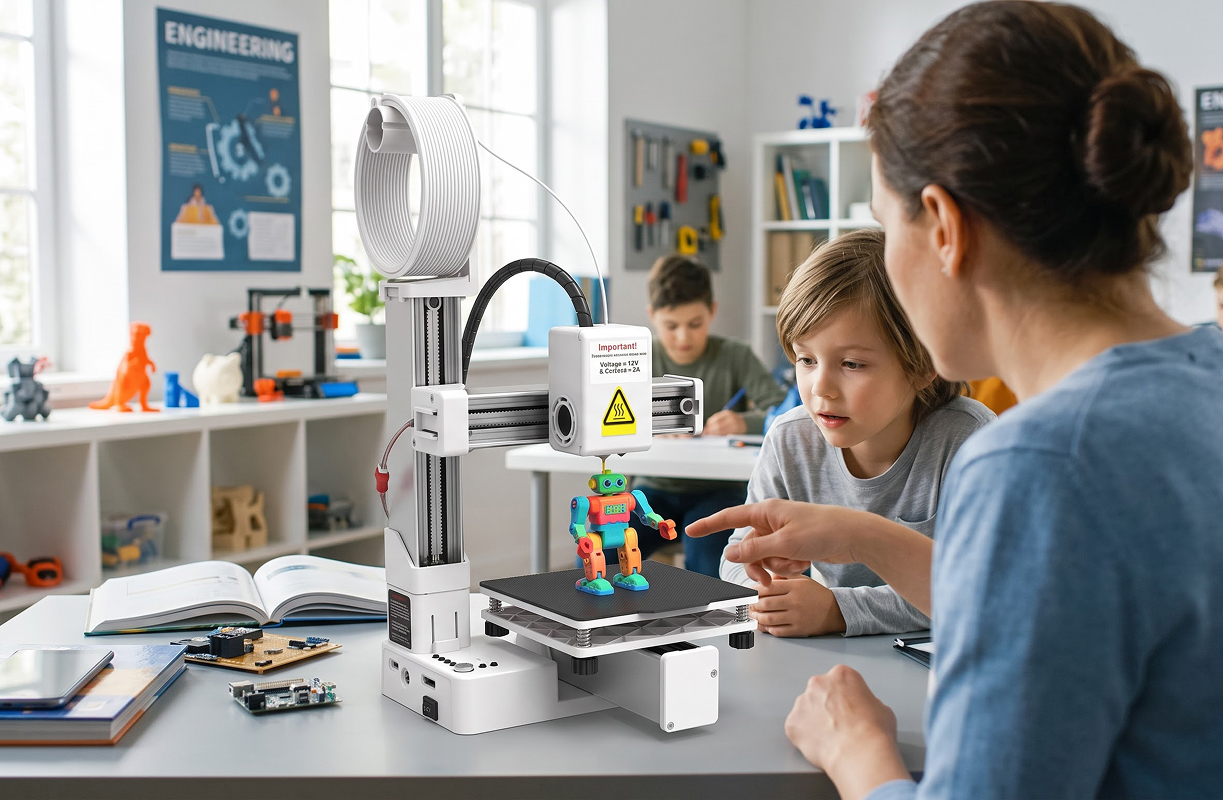
Setting up your first fabrication setup should feel exhilarating, yet countless beginners face an absolute nightmare of failed first layers, tangled spools, and cryptic firmware errors that ruin initial excitement. 🛑 Dealing with warped prints or uneven heated beds can turn a promising hobby into an exhausting, painful struggle.
Trying to assemble poorly documented kits late at night leaves many novices completely anxious and stranded with broken components. 😥 Nothing is more terrifying than watching hours of progress disintegrate into a chaotic nest of plastic spaghetti because manual leveling drift ruined the foundation.
Finding a dependable machine should not demand an advanced engineering degree or endless mechanical calibration routines. Our comprehensive guide eliminates the guesswork by testing and showcasing the best 5 entry level 3D printers capable of delivering smooth, stress-free results immediately out of the box. ✨
We examine critical hardware factors including bed leveling reliability, thermal stability, software ease, and mechanical construction. Continue reading to discover our detailed evaluation metrics and find your ideal printing companion today.
We evaluate out-of-the-box assembly simplicity, intuitive touchscreen interfaces, automated bed leveling accuracy, and beginner-friendly slicer software integration.
We test layer line consistency, dimensional accuracy, fine detail reproduction, overhang performance, and extrusion reliability across various standard materials.
We assess maximum linear velocities, frame rigidity, resonance suppression, motor dampening technologies, and cooling efficiency during intense print cycles.
We analyze power loss recovery resilience, run-out filament sensors, thermal runaway protections, noise levels, and overall mechanical longevity under stress.
The LayerPryn Entry Level 3D Printer establishes a benchmark in modern compact manufacturing, providing an ultra-accessible gateway for makers stepping into digital fabrication. Engineered specifically with simplicity at its core, this lightweight powerhouse removes intimidation factors through streamlined hardware architecture. It supports standard 1.75mm PLA and flexible TPU filaments, ensuring high material versatility straight from initial unpacking. 🚀
Equipped with an optimized build volume of 100 x 100 x 100mm, the machine achieves a dependable printing precision of 0.1mm for desktop models. Its motion system maintains steady output rates between 30mm/s and 40mm/s, delivering smooth layer deposition without inducing mechanical jitter. Operating near total silence, this system integrates effortlessly into quiet study spaces, home classrooms, and personal workbenches without disruptive operating noise.
Software workflow is frictionless thanks to the included Easyware automated slicing suite, while also maintaining robust compatibility with industry-standard CURA software. Users can execute one-touch physical print commands or utilize offline TF card printing without requiring dedicated computer tethering. This independence prevents common computer sleep-mode failures, guaranteeing that small prototypes, figurines, and household gadgets finish reliably from start to finish. 💡
Crafted to serve educational environments and DIY hobbyists alike, the structural assembly prioritizes durable safety alongside minimal maintenance requirements. The integrated power supply ensures consistent thermal regulation across prolonged jobs, while the lightweight chassis enables seamless relocation between classrooms or workshop desks. Beginners can readily explore dimensional crafts with zero complex calibration routines or overwhelming parameter configurations. ✨
Ultimately, this unit delivers exceptional user confidence through clear documentation, bundled sample files, and intuitive single-button operations. By bridging the gap between mechanical sophistication and plug-and-play ease, the LayerPryn Entry Level 3D Printer stands as an unbeatable launchpad for aspiring designers seeking reliable, small-scale desktop production.
The Anycubic Kobra X Multicolor 3D Printer expands creative potential through native multi-material handling, supporting four standard colors and scalable configurations up to nineteen distinct filaments. Its sophisticated adaptive extrusion force compensator effortlessly manages rigid materials alongside soft flexible filaments like 68D TPU. This versatility makes the unit an appealing tool for designers seeking advanced multi-hue visual presentations.
Equipped with modern high-speed kinematics, this platform reaches rapid print velocities up to 600mm/s printing power while preserving surface detail. The underlying Kobra operating system deploys dynamic vibration compensation algorithms that actively minimize resonance artifacts during rapid direction changes. Consequently, decorative models, educational parts, and detailed enclosures retain smooth wall textures even at aggressive production tempos.
Initial installation is remarkably simple, enabling complete beginners to achieve their inaugural successful print within roughly fifteen minutes from unboxing. The system features LeviQ 3.0 automatic bed leveling, which maps forty-nine distinct bed points to eliminate initial layer gaps and adhesion issues. This fully automated sensor array removes the traditional hassle of manual sheet adjustments and nozzle offset guesswork.
Operating at sound levels below forty-eight decibels, the chassis remains quiet enough for shared living areas and study environments. Enhanced fail-safe features including intelligent power loss recovery and active filament run-out detection safeguard extensive multi-hour jobs against unexpected disruptions. These reliable protections ensure that complex, multi-material projects finish successfully without wasted spools or time.
The Longer LK5 Pro 3D Printer is engineered for makers demanding substantial construction capacity, providing an impressive build volume of 300x300x400mm. Arriving ninety percent pre-assembled, users can quickly construct the framework without tedious mechanical calibration. Its reinforced diagonal structural rods create a rigid triangular geometry that significantly mitigates top-heavy frame oscillation during tall printing tasks.
Cooling performance is bolstered by an upgraded dual blower kit, engineered to rapidly solidify extruded plastic as it exits the heated nozzle. This targeted airflow prevents thermal model sagging, bridges large spans cleanly, and minimizes unsightly stringing across detailed geometric contours. The resulting surface finishes stay crisp across challenging architectural models and mechanical components alike.
Interacting with the machine is effortless via the generous 4.3-inch full color touchscreen, replacing antiquated rotary knobs with an intuitive modern visual interface. Users can monitor temperatures, adjust feed rates, and review file progress through clear, responsive digital menus. The open-source motherboard further empowers advanced hobbyists to customize firmware parameters and integrate custom sensory modifications over time.
A textured lattice glass platform ensures flat thermal distribution across the spacious print bed while facilitating smooth part release once fully cooled down. Supported by ultra-quiet TMC2208 stepper motor drivers, the printer glides silently across prolonged printing cycles. Built-in filament run-out detection and resume-printing capabilities provide dependable defense against spoiled prints during power interruptions.
The Anet ET4 Pro 3D Printer focuses on modular convenience, allowing users to assemble the entire pre-built aluminum profile frame in approximately ten minutes. Engineered for safety and structural rigidity, the all-metal chassis minimizes frame flexing during rapid axis movements. This robust build makes it an excellent choice for educational environments, home workshops, and design labs.
Precision leveling is governed by a photoelectric induction auto-leveling system, collecting twenty-five distinct positional data points across the heated print plate. This matrix compensation guarantees that the initial extruded layer adheres uniformly across the entire surface area without tedious manual knob turning. Reliable first-layer adhesion substantially reduces the likelihood of warped edges or detached prints.
Operating noise is kept to an absolute minimum thanks to integrated TMC2208 motor driver chips, providing two hundred fifty-six micro-step subdivisions for refined motion control. The ultra-smooth signal delivery minimizes mechanical resonance, translating into finer wall finishes and cleaner curved contours. Meanwhile, a full-color 2.8-inch touchscreen interface ensures seamless control over preheating, file selection, and diagnostic functions.
Material management is streamlined through one-click automatic filament loading and unloading mechanisms, eliminating tricky manual spool feeding routines. An integrated run-out sensor alerts users and pauses operations when the spool empties, while robust power recovery resumes print jobs seamlessly after electrical outages. Firmware updates can also be flashed directly via memory card for continuous hardware optimizations.
The ELEGOO Jupiter 2 Resin 3D Printer represents an alternative additive manufacturing approach, utilizing photopolymer liquid resin to achieve microscopic surface detail that standard filament printers cannot match. Paired in a comprehensive bundle with the Mercury X separate washing and curing stations, this package delivers a complete post-processing workflow. It is specifically tailored for jewelers, miniature tabletop enthusiasts, and intricate character modelers.
Built upon an exceptionally durable metal framework, the printer ensures maximum mechanical rigidity to avoid layer shifting across extensive build cycles. The high-precision light engine projects uniform ultraviolet exposure across the liquid vat, hardening photopolymer layers with sub-millimeter accuracy. This precise exposure delivers glass-smooth surface contours and razor-sharp structural edges on delicate model features.
Handling post-processing is made significantly cleaner through the Mercury X washing and curing bundle, which automates necessary alcohol rinsing and secondary UV light solidification. By standardizing these post-print steps into automated wash cycles and turntable UV curing, users achieve uniform part durability without sticky un-cured resin residues. The streamlined stations save significant manual cleanup effort over standard resin workflows.
Broad chemical compatibility allows the unit to process standard, plant-based, water-washable, and ABS-like liquid photopolymers for varying functional requirements. The heavy-duty ball screw Z-axis drive provides smooth vertical motion, virtually eliminating horizontal layer bands. For hobbyists seeking pristine visual fidelity, this professional setup delivers uncompromised resin detail rendering straight out of the box.
Entry level 3D printers are accessible desktop additive manufacturing machines designed to convert three-dimensional digital designs into tangible plastic or resin physical objects. These compact fabrication systems empower hobbyists, students, and DIY creators to fabricate custom replacement components, artistic miniatures, decorative items, and functional household prototypes easily.
Most beginner machines utilize Fused Deposition Modeling technology, which heats thermoplastic spools like PLA or TPU and extrudes them layer by layer upon a flat platform. Alternatively, beginner stereolithography devices harden liquid photopolymers utilizing precision ultraviolet light matrices for exceptional miniature detail reproduction.
Modern starter printers feature automated sensor calibration, whisper-quiet motor stepper chips, and pre-assembled modular frames that eliminate tedious mechanical assembly. Integrated protective features such as power loss recovery and filament run-out monitoring safeguard long multi-hour print jobs against unforeseen hardware disruptions.
By pairing streamlined computer slicing applications with intuitive onboard touch controls, these versatile machines make digital manufacturing effortless. Users can effortlessly transform digital blueprints into physical items without requiring specialized machining tools or complex industrial expertise.
Thomas Hunter - Research Specialist
© 2023 TopStarSelect, LLC. All Rights Reserved.
Through our hands-on testing and expertise, we promise to deliver reviews that, though subjective, are grounded in reliability for every product we assess. Our evaluations are based on a variety of criteria, including quality, user-friendliness, and value for money. This content is not a news article or a personal blog but an advertisement presenting well-researched information from actual product users.


