
In-Depth Product Analysis for Informed Consumer Choices

By Adam Clarke
Watching your prized indoor foliage wither away is an absolute nightmare for any plant lover. I had a painful experience when my rare variegated monstera dropped half its leaves because I relied on visual guesswork instead of factual data. 🌿
Attempting to evaluate subtle brightness shifts without a dedicated instrument creates an anxious, terrifying routine of trial and error. Navigating complex optical specifications makes choosing the right light meter for plants an exhausting and difficult decision.
This comprehensive buying guide provides the definitive solution to protect your indoor botanical investments from permanent photic damage. We evaluated dozens of illuminance sensors to determine the best 5 light meters for plants that deliver verified accuracy and durability. 🪴
Read our in-depth evaluation criteria below to discover which handheld optical device best fits your specialized horticultural layout.
Evaluates the accuracy of photosynthetically active radiation and illuminance sensor readings across various grow light spectra.
Measures the real-time data sampling speed and sensor stability during immediate indoor light condition shifts.
Assesses the instrument capacity to accurately register ultra-low ambient lumens up to intense direct sunlight.
Examines sensor head adjustability, display readability, and onboard data-logging convenience in tight greenhouse environments.
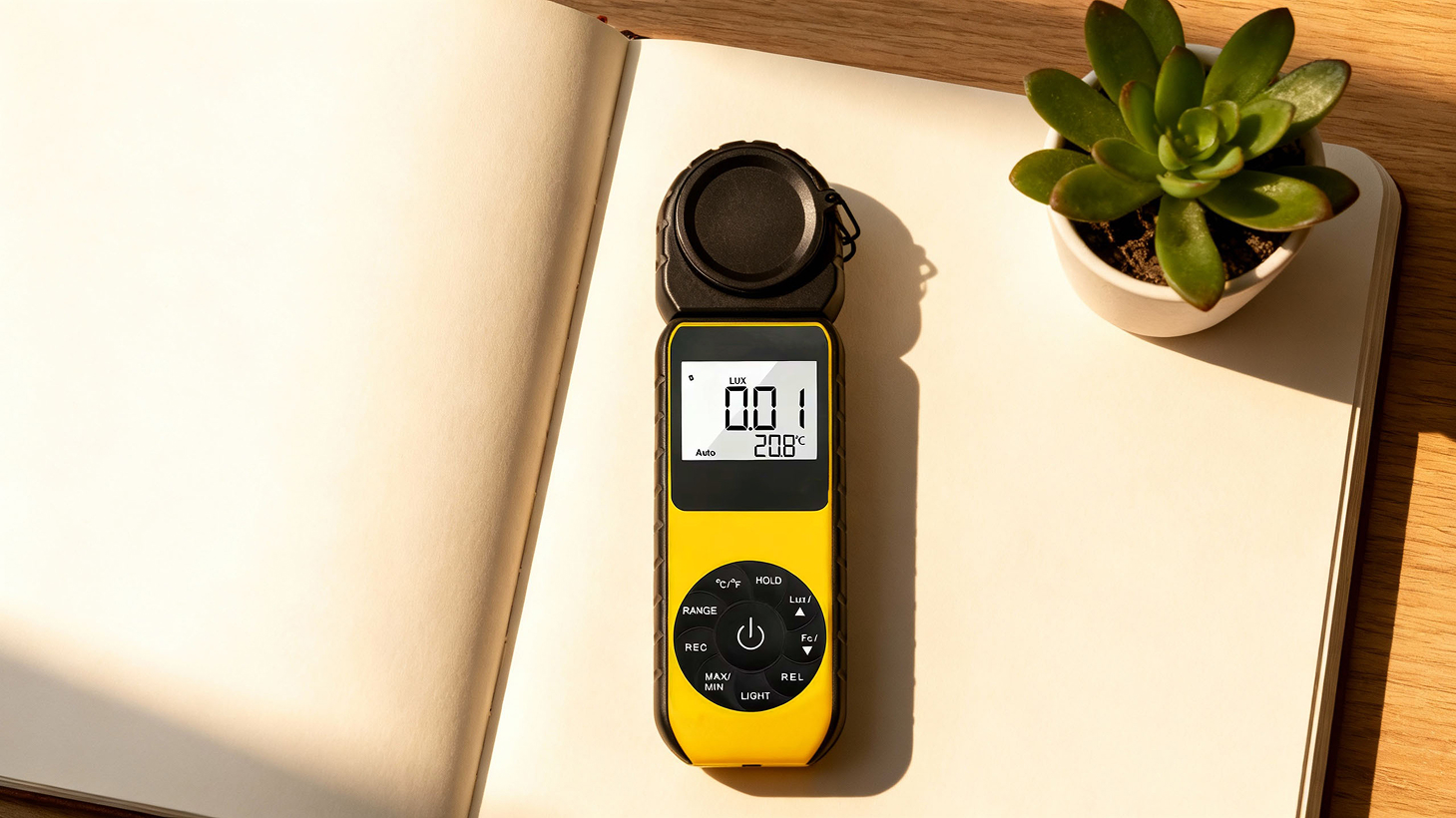
Indoor gardening reaches new heights of precision with the PlantyLit light meter from HOLDPEAK. Delivering unmatched performance across domestic and commercial setups, it eliminates the guesswork of canopy illumination. The device utilizes an advanced silicon photodiode optical filter capable of handling intense multi-spectrum arrays, making it the undisputed market leader for dedicated botanical enthusiasts. 🌿
Equipped with a rapid 0.4-second response time and dual sampling per second, this digital instrument offers immediate data verification for finicky indoor flora. The ultra-wide dynamic span measuring from 0.01 to 400,000 Lux ensures you can test everything from gentle shade foliage to aggressive high-output horticultural fixtures without experiencing measurement ceiling clipping or signal distortion. 📊
A major design breakthrough is the 270-degree rotational sensor head that lets horticulturists take precise readings from intricate angles without contorting the main unit. This thoughtful ergonomic articulation allows growers to monitor top leaves, lateral stems, and under-canopy foliage directly while keeping the high-contrast backlit LCD screen comfortably positioned in their direct line of sight.
Beyond basic instantaneous measurements, the unit features an internal memory capable of storing 33 sets of data readings alongside real-time ambient temperature tracking. The integrated relative measuring mode instantly calculates the exact mathematical variance between distinct points in your grow room, enabling seamless micro-climate mapping across tiered vertical shelving systems.
The rugged exterior housing includes a tactile protective grip, physical data hold functionality, and automatic bar graph displays for visual trend monitoring. Whether you are balancing sensitive tropical orchids or cultivating high-light culinary herbs, the reliable optical auto-ranging system guarantees steady foot-candle and lux conversions across varied artificial lighting environments. 🪴
Cultivating lush, healthy greenery demands uncompromising light consistency, and investing in the PlantyLit optical sensor guarantees the exact illuminance metrics required for superior photosynthetic development throughout every growth phase.
The Dpofirs Light Meter serves as a specialized ultraviolet radiometer engineered for indoor horticulturists monitoring supplemental radiation spectrums. It accurately evaluates critical UVA and UVB wavebands between 290 and 390 nanometers, ensuring artificial grow fixtures do not emit excessive radiation that scorches sensitive plant tissues. This instrument provides an essential diagnostic safety tool for hobbyists deploying full-spectrum lighting systems.
Featuring three distinct measurement ranges up to 40mW per square centimeter, the device accommodates both low-level ambient testing and concentrated fixture outputs. The built-in UV color correction filter enhances measurement consistency across varying horticultural lighting systems. Incorporating a responsive half-second rapid sampling rate, it updates illuminance changes instantly on the large LCD display.
The unit is constructed from lightweight, shock-resistant ABS material, allowing easy one-handed mobility throughout extensive greenhouse setups. Powered by a standard nine-volt battery, the integrated circuit design delivers dependable energy efficiency during prolonged diagnostic testing cycles. Its clear 33/4-bit high-contrast digital screen offers effortless reading in bright outdoor sunlight or dim indoor grows.
While the tool focuses primarily on ultraviolet radiation rather than broad visible lumens, it provides vital supplemental data for advanced indoor plant cultivators. Combining a rugged build with portable storage accessories, the reliable ultraviolet detection sensor ensures high-intensity reptile or botanical discharge lamps perform safely within manufacturer tolerances.
The Generic Light Meter handheld quantum PAR meter is specifically engineered to measure photosynthetically active radiation flux from modern LED grow lights. Covering critical photosynthetic wavelengths between 400 and 700 nanometers, this device delivers uncompromised quantum photosynthetic accuracy for high-density plant setups. It represents a cost-effective alternative to bulky commercial laboratory equipment.
Unlike traditional lux illuminance meters that miscalculate narrow LED peaks, this instrument features a constant linear response curve across the full growth spectrum. It registers light levels up to 10,000 micromoles per square meter per second, surpassing typical hobbyist tools. The unit incorporates patented automatic optical calibration modes to ensure consistent readings under varied solid-state horticultural lighting.
Equipped with an internal rechargeable battery, the meter charges completely in two hours via any standard USB port, eliminating repetitive single-use battery costs. The integrated low-battery indicator prevents unexpected field shutoffs during critical diagnostic sessions. Its advanced proprietary optical data logging software facilitates detailed light saturation mapping across diverse indoor crops.
Designed with a slim handheld profile, this instrument travels easily between multi-tier racking systems and dedicated grow tents. The streamlined interface allows rapid spot checks above dense plant canopies. By delivering true photon flux density metrics, it serves as an invaluable photosynthetic diagnostic tool for indoor cultivators maximizing leafy yields.
Manufactured in the United States by Solar Light Company, the Solarmeter Light Meter Model 5.7 is an industrial-grade ultraviolet radiometer designed to measure total UVA and UVB irradiance. Calibrated to rigorous NIST-traceable standards, it provides exceptional laboratory measurement precision for greenhouse managers tracking supplemental lighting degradation. It allows growers to replace aging specialized light bulbs before reduced radiation diminishes crop vigor.
Featuring a dedicated measurement range from 0 to 1999 microwatts per square centimeter, this radiometer excels at assessing shielding transmission and window tinting. The rugged housing withstands accidental drops and high-humidity greenhouse environments. Operating via a simple single-button activation interface, it provides immediate readings on a clear LCD screen without requiring complex menu navigation.
The device is powered by an included nine-volt DC battery engineered to deliver up to two full years of typical operational life. Each instrument comes complete with an individual NIST-traceable calibration reference card verifying optical sensor fidelity. This high level of quality control makes it a dependable diagnostic asset for phototherapy monitoring, reptile enclosures, and high-value indoor crop cultivation.
While primarily focused on ultraviolet irradiance rather than broad photometric lumens, it serves a critical niche for experienced growers managing complex lighting recipes. Its consistent performance under intense environmental heat makes the Solarmeter a trusted long-term diagnostic investment for maintaining optimal environmental safety and spectral balance.
The LIFEES Light Meter is an upgraded digital radiometer engineered to help home gardeners balance light intensity across indoor foliage and carnivorous plants. Utilizing an integrated quantum sensor, it measures photosynthetically active radiation flux across the 400 to 700 nanometer spectrum. This device provides accessible quantum photosynthetic metrics at a fraction of the cost of high-end industrial alternatives.
This instrument is compatible with modern solid-state LED fixtures, high-pressure sodium lamps, and traditional ceramic metal halide systems. It accurately registers photosynthetically active photons to prevent accidental leaf bleaching in sensitive species like droseras. The handheld unit incorporates ninety-nine internal memory logging slots, enabling comprehensive multi-point light mapping across dense indoor foliage arrangements.
Featuring straightforward push-button controls, the meter simplifies daily canopy maintenance for hobbyists and experienced botanists alike. Its lightweight plastic construction ensures comfortable handling when scanning multiple hanging planters or tiered shelving units. The clear digital LCD readout panel displays real-time photosynthetic photon flux density without requiring mathematical conversions.
Backed by a reassuring two-year service warranty, this tool offers dependable diagnostic support for indoor gardeners refining their supplemental light schedules. While it lacks advanced computer sync software, its straightforward handheld operational design makes it a valuable entry-level quantum meter for indoor garden maintenance.
A light meter for plants is a specialized optical instrument engineered to measure the intensity and spectral energy of illumination reaching indoor plant canopies. Unlike the human eye, which adjusts automatically to brightness, these sensors deliver objective mathematical data regarding real light levels.
Traditional photometers measure illuminance in lux or foot-candles, which evaluates visible brightness based on human visual sensitivity. These tools work well for tracking baseline ambient conditions, seasonal natural light shifts, and general household foliage placement.
Advanced horticultural meters quantify photosynthetically active radiation (PAR) within the 400 to 700 nanometer wavelength range. This measures actual photon flux density driving botanical photosynthesis under modern LED and high-intensity discharge fixtures.
Using a dedicated plant photometer prevents common cultivation errors like canopy light starvation or photic leaf bleaching. It ensures indoor botanists maintain balanced energy conditions for vigorous, long-term plant health.
Adam Clarke - Research Specialist
© 2023 TopStarSelect, LLC. All Rights Reserved.
Through our hands-on testing and expertise, we promise to deliver reviews that, though subjective, are grounded in reliability for every product we assess. Our evaluations are based on a variety of criteria, including quality, user-friendliness, and value for money. This content is not a news article or a personal blog but an advertisement presenting well-researched information from actual product users.


